Architecture
This page describes the internal design of Vanilla.PDF: the layered architecture, object model, memory model, thread-safety invariants, and extension points.
For the public C API conventions (handles, error codes, cleanup patterns), see C API Guide.
Three-layer architecture
The library is organized into three layers, each with a distinct responsibility. Higher layers depend on lower ones; the C interface layer sits alongside all three and maps internal C++ objects to opaque handles.
Layer |
Source location |
Responsibility |
|---|---|---|
Syntax |
|
PDF object types, tokenizer, parser, XRef tables, file I/O, compression filters (Flate, DCT, JPX, ASCII85, ASCIIHex, LZW) |
Semantics |
|
High-level document model: documents, catalogs, page trees, pages, annotations, interactive forms, digital signatures, outlines, named destinations, fonts, resource dictionaries |
Contents |
|
Content stream parsing and instruction processing for PostScript-style page content (text operations, graphics state, inline images) |
The C interface wrappers live in src/vanillapdf/implementation/ and
translate between opaque handles and the internal C++ classes. Public headers
are in include/vanillapdf/.
Why ANSI C?
The C++ ABI is not stable across compilers or across major versions of the
same compiler. A native C++ interface would force every consumer to use the
exact same toolchain. By exposing only ANSI C functions with cdecl calling
conventions, the library can be linked by any C or C++ compiler and called
from any language with a C FFI.
Functions across the interface use the standard C caller-cleanup
cdecl
calling convention. On x86, this is enforced with __cdecl (MSVC) or
__attribute__((cdecl)) (GCC). On other architectures, the default calling
convention is used.
Object model
Handle types
All objects exposed through the C API are opaque handles – typed pointers to
internal C++ structures. Handles are declared using the
DECLARE_OBJECT_HANDLE macro, which creates a forward-declared struct tag:
// From c_handles.h
#define DECLARE_OBJECT_HANDLE(x) \
    typedef struct x##HandleTag x##Handle
This ensures that DocumentHandle* and FileHandle* are distinct pointer
types at the compiler level, preventing accidental misuse.
The handles fall into four categories matching the three layers plus utilities:
Syntax layer handles – PDF primitive objects and file structure:
ObjectHandle,ArrayObjectHandle,BooleanObjectHandle,NameObjectHandle,IntegerObjectHandle,RealObjectHandle,StringObjectHandle,StreamObjectHandle,DictionaryObjectHandle,NullObjectHandleFileHandle,FileWriterHandle,XrefHandle,XrefEntryHandleFilter handles:
FlateDecodeFilterHandle,DCTDecodeFilterHandle,ASCII85DecodeFilterHandle,ASCIIHexDecodeFilterHandle,LZWDecodeFilterHandle,JPXDecodeFilterHandle
Semantics layer handles – document-level objects:
DocumentHandle,CatalogHandle,PageTreeHandle,PageObjectHandle,PageContentsHandleDigitalSignatureHandle,DocumentSignerHandle,DocumentSignatureSettingsHandleInteractiveFormHandle,FieldHandle,SignatureFieldHandleOutlineHandle,AnnotationHandle,NamedDestinationsHandleFontHandle,ResourceDictionaryHandle,DateHandle,RectangleHandle
Contents layer handles – content stream objects:
ContentObjectHandle,ContentOperationHandle,ContentInstructionHandle,ContentParserHandleText operations:
ContentOperationTextFontHandle,ContentOperationTextShowHandle,ContentOperationBeginTextHandle
Utility handles – I/O, buffers, cryptography:
BufferHandle,InputStreamHandle,OutputStreamHandleSigningKeyHandle,EncryptionKeyHandle,PKCS12KeyHandleTrustedCertificateStoreHandle,SignatureVerificationResultHandle
Internal class hierarchy
Internally, all syntax-layer objects inherit from Object, which itself
derives from IUnknown (the reference-counting base):
// Simplified from src/vanillapdf/syntax/objects/object.h
class Object : public virtual IUnknown,
               public IWeakReferenceable<Object>,
               public IModifyObservable {
    // Type system, offset tracking, XRef entry, dirty flag, attributes
};
Semantics-layer objects use a template wrapper:
// From src/vanillapdf/semantics/objects/high_level_object.h
template <typename T>
class HighLevelObject : public virtual IUnknown {
    // Wraps a syntax-layer object with semantic meaning
};
This separation means the semantic layer (DocumentHandle,
PageObjectHandle) operates on top of the syntax layer
(DictionaryObjectHandle, StreamObjectHandle) without exposing the
lower-level structure to callers.
Memory model
Reference counting
The library uses intrusive reference counting. The reference counter is
embedded directly inside each object, not in a separate control block. This
gives two advantages over std::shared_ptr:
Single allocation – object and counter are allocated together
Single dereference – accessing the object does not require a second pointer hop through a control block
When an API function returns a handle through an output parameter, the caller
owns one reference. The caller must call the corresponding _Release
function when done. Releasing a handle decrements the counter; when it reaches
zero, the object is destroyed.
DocumentHandle* doc = NULL;
Document_Create("output.pdf", &doc);   // refcount = 1

/* ... use the document ... */

Document_Release(doc);                 // refcount = 0 → destroyed
Rules:
Always initialize handles to
NULLbefore use.Release handles in reverse order of acquisition.
Never use a handle after releasing it.
Double-releasing a handle is undefined behavior.
Weak references
The library supports weak references for objects that need to observe other
objects without preventing their destruction. Weak reference counters use
std::atomic<bool> for thread-safe deactivation:
// From src/vanillapdf/utils/unknown_interface.h
class WeakReferenceCounter {
    std::atomic<bool> m_active;
};
Thread safety
Vanilla.PDF is thread-safe. The library does not use global mutable state, and key internal objects are protected by mutexes and atomics.
Error context is thread-local. Each thread maintains its own error code and message buffer:
// From src/vanillapdf/utils/errors.h
static thread_local uint32_t m_error;
static thread_local size_type m_message_length;
static thread_local char m_message[constant::MAX_MESSAGE_SIZE];
The buffer is pre-allocated to avoid allocation failures when reporting out-of-memory errors.
Object-level locking. Core PDF objects use std::recursive_mutex to
protect concurrent access. Each object owns its mutex via
std::unique_ptr<std::recursive_mutex>:
DictionaryObjectStreamObjectStringObjectBase(literal and hexadecimal)IndirectReferenceObjectXrefUsedEntryBase
Reference counting is atomic. IUnknown::m_ref_counter uses
std::atomic<uint32_t>, and WeakReferenceCounter::m_active uses
std::atomic<bool>, so reference management is safe across threads.
Document opening is thread-safe. Document::OpenFile atomically
returns the existing document or creates a new one for a given file,
preventing race conditions when multiple threads open the same file.
Logging is thread-safe. The logging subsystem uses spdlog
multi-threaded sinks (rotating_logger_mt, custom_callback_sink_mt
with internal std::mutex). Calling Logging_Enable() or writing log
output from any thread is safe.
Error handling
Internally, the library uses C++ exceptions. Each C interface function wraps its implementation in a try-catch block that catches all exceptions, stores the message in the thread-local buffer, and returns an error code:
error_type Buffer_SetData(BufferHandle* handle, string_type data, size_type size) {
    Buffer* obj = reinterpret_cast<Buffer*>(handle);

    if (obj == nullptr) {
        return VANILLAPDF_ERROR_PARAMETER_VALUE;
    }

    try {
        obj->assign(data, data + size);
        return VANILLAPDF_ERROR_SUCCESS;
    } catch (std::exception& e) {
        // Store e.what() in thread-local buffer
        return VANILLAPDF_ERROR_GENERAL;
    } catch (...) {
        return VANILLAPDF_ERROR_GENERAL;
    }
}
Note
The wrapping try-catch has negligible performance impact on modern compilers using table-based exception handling.
Extension points
The library provides callback interfaces that callers can implement to customize behavior without modifying the library itself.
Interface |
Purpose |
|---|---|
|
Custom signing implementation for smart cards or HSMs where the
private key is not directly accessible. Override instead of using
|
|
Custom encryption key provider for certificate-based decryption or external key management systems. |
|
Callback interface invoked during PDF file writing. Allows callers to monitor or modify the output process. |
|
Pluggable file I/O backend. Two implementations ship in-box: an
in-memory |
For signing, the standard approach uses PKCS#12 key files (RFC 7292):
PKCS12KeyHandle* pkcs12 = NULL;
SigningKeyHandle* key = NULL;

PKCS12Key_CreateFromFile("key.p12", "password", &pkcs12);
PKCS12Key_ToSigningKey(pkcs12, &key);
Document_Sign(doc, file, key, settings);
When the private key resides on a smart card or HSM, implement
SigningKeyHandle directly and provide your own signing logic.
See sign_custom.c for an example.
File layer internals
The file layer provides access to PDF file contents at the syntactic level.
IO streams
The library uses C++ I/O streams internally. The public interface exposes two stream types:
InputStreamHandle– for reading source filesOutputStreamHandle– for writing output files
For custom I/O backends (memory-mapped files, network streams, encrypted blob
stores), implement IoStrategyHandle. Two ship in-box: an in-memory buffer
strategy and a file-stream strategy.
Tokenizer
The tokenizer produces the smallest syntactic elements, separated by whitespace or delimiters as defined in section 7.2 of the PDF specification.
The tokenizer uses look-ahead to disambiguate tokens. For example,
< begins a hexadecimal string, while << begins a dictionary:
int c = m_stream->Get();
if (c == Delimiter::LESS_THAN_SIGN) {
    int ahead = m_stream->Peek();
    if (ahead == Delimiter::LESS_THAN_SIGN) {
        return Token::Type::DICTIONARY_BEGIN;
    }
    // ... read hex string ...
    return Token::Type::HEXADECIMAL_STRING;
}
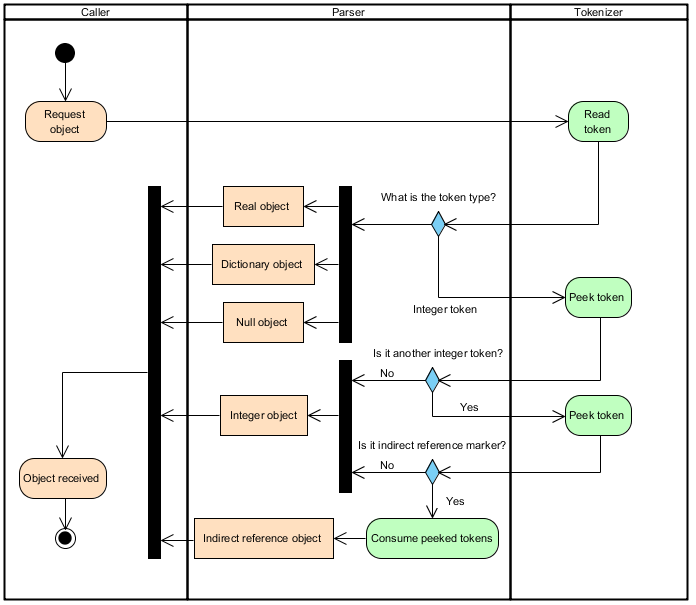
Parser
The parser consumes tokens and constructs PDF objects. It also uses
look-ahead, since multiple tokens may form a single object (e.g., an
indirect reference is three tokens: object number, generation number, R).
Indirect references
IndirectReferenceObjectHandle must often be resolved to access the
referenced object. For example, StreamObjectHandle frequently stores its
Length as an indirect reference. The file layer resolves these references
transparently during parsing.
Quality assurance
Beyond the unit and integration test suites, the project runs two additional correctness lines:
Fuzzing. libFuzzer-based targets under
src/vanillapdf.fuzzer/exercise the parser, content streams, and decompression filters (Flate, DCT, JPX, ASCII85, ASCIIHex) against a seed corpus. Continuously run via.github/workflows/fuzzing.yml.External conformance.
scripts/conformance_check.pyruns a qpdf-based PDF conformance suite over generated output to catch malformed files that pass the library’s own checks. Continuously run via.github/workflows/conformance-check.yml.
Both feed back into the test corpus when they find issues.
Dependencies
Library |
Purpose |
|---|---|
Encryption, decryption, and digital signatures |
|
Flate compression |
|
JPEG image decoding |
|
JPEG2000 image support |
|
Logging |
|
Configuration parsing |
All dependencies are managed automatically via vcpkg. See Building from Source for details on using system packages instead.
Build system
The build uses CMake with platform-specific presets defined in
cmake/presets/. CMake also integrates CPack for generating installable
packages:
Debian
.debpackagesHomebrew packages
NuGet packages
See Building from Source for build instructions and Packaging for package generation.